Original report pages 11–16.
(Appeared in The Ringing World, 10 March 1989)
Early risers may have heard a ringer from Kensington interviewed on the ‘Sunday’ programme on Radio 4, just before Christmas last year. He claimed that there are about 100,000 ringers. He may be right; in fact if he was referring to all people who have been taught to ring he was undoubtedly understating the situation very significantly. If we look just at currently active ringers, however, those who are members of bands and who can be called upon to ring, especially on Sundays, the figure is almost certainly less than half of the claimed 100,000. This is a conclusion drawn from the recently-conducted Central Council Survey of Ringing, and in this second article based on their work, the members of the Survey Committee indicate how many ringers they think there are, and what the average size of bands is.
Counting the Ringers
One of the initial tasks carried out by those administering the questionnaires was to inquire how many ringers are associated with each of the 500 towers surveyed. This was done by making contact with the Tower Captain, through the incumbent in many cases, and asking her or him for a list of all the ringers in the local band. This obviously raised a number of difficulties, because many were unclear whether a particular individual should be counted or not. It was impossible to draw up precise rules about inclusion/exclusion, so the agents were instructed to get a list of ‘all the people who are members of the band’ and to
Interpret ALL members to mean: everybody who rings on Sundays and/or practice nights, and the tower captain considers to be members of the band, including infrequent/irregular attenders …, because the survey is to cover all ringers
Queries were still raised, of course, about students away at school or higher education, for example, and whether learners who could not yet handle a bell in rounds should be included. On the first, we suggested that they should be included if they rang at the tower regularly for at least part of the year; on the second, the advice was only include them if they are able to ring unaided.
p. 12 No doubt there were some inconsistencies, but we believe we have got as close as possible to a proper count of the number of ringers associated with the 500 towers. There may be a little double-counting, notably in areas where many ringers serve more than one tower (certainly there are some who act as tower captain at more than one), but this shouldn’t lead to significant inaccuracies (though see Chapter 11). And, of course, we exclude those who are active ringers (we imagine that most of them are active peal ringers) who are not associated with any tower and who do not contribute substantially to the week-by-week activities of training learners, helping others to advance, and keeping the sound of the bells pealing out on Sundays.
So what did we find? We have returns available for 471 of the 500 towers, and these form the basis of the findings presented here. It is doubtful whether the data from the other 29, when available, will significantly alter the results.
We categorised the 471 towers into six groups, as follows:
The 471 towers with returns, by category
| 1) Unringable: no ringers |
31 |
| 2) Unringable: some ringers (bells presumably temporarily unringable) |
2 |
| 3) Ringable: no ringers |
41 |
| 4) Ringable: tower captain but no other ringers |
23 |
| 5) Ringable: local band |
366 |
| 6) Special cases |
8 |
Thus there was a band at 78 per cent of the surveyed towers, and at 84 per cent of those with ringable bells. (The special cases were mainly towers where ringing is not possible at present, because the church has recently been made redundant, for example: they included one church where the bells were removed between the taking of the sample and the actual conduct of the survey.)
There appear to be more towers with bands than towers where the bells are rung regularly on Sundays. (Our first article - The Ringing World, 17 February 1989; Chapter 3 - showed that the bells were rung regularly on Sundays at only 62.5 per cent of the surveyed towers.) The reason for this difference seems to be that a substantial number of bands are too small to ring the bells regularly.
Chapter 3 gives this figure as 62.8 per cent, not 62.5.
Number of Bells and Number of Ringers
If we use the above categorisation, excluding the eight special cases, we see significant differences between towers according to the number of bells. Table 4.1 gives the percentages of towers in each category, according to the number of bells there. Thus all of the rings of 12 in the Survey are ringable and have bands of ringers, compared to less than half of the rings of 5. Perhaps not surprisingly, since a large number of them are in small villages, the rings of 5 are much more likely either to be unringable or, if they are ringable, to lack a band of ringers than are the towers with 6, 8, 10 or 12 bells.
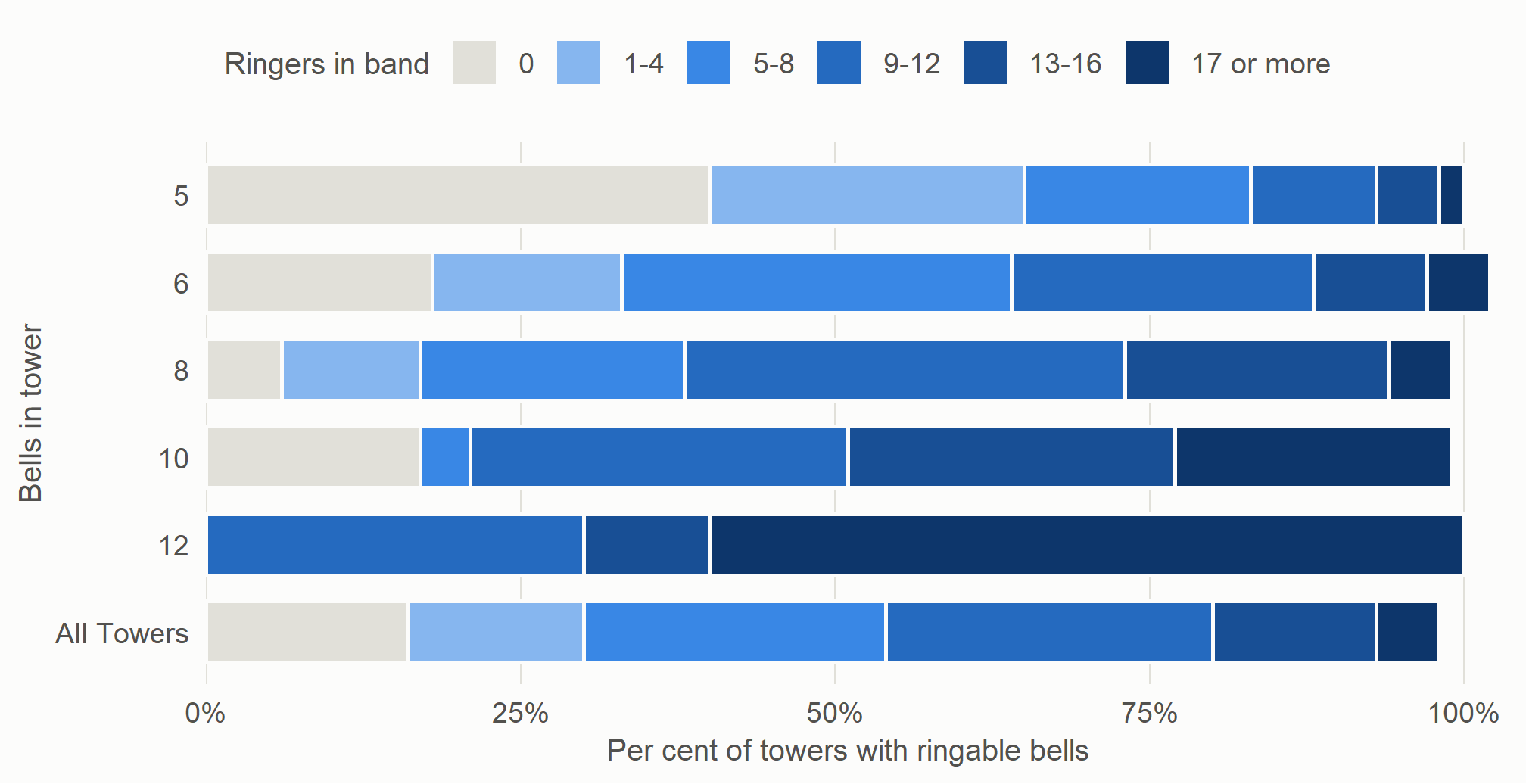
p. 13 How large are the bands? Table 4.2 gives the percentages with different band sizes at all towers where the bells are ringable, and according to the number of bells. (The numbers in each column may not sum exactly to 100 because of rounding errors.) In general, the towers with more bells have bigger bands, with 60 per cent of the 12-bell bands comprising 17 or more ringers, for example, whereas 65 per cent of the 5-bell towers have fewer than five ringers. The rings of 10 form a partial exception to this generalisation, with 17 per cent of them having no ringers even though the bells are ringable. There were only 23 10-bell towers in the sample, however, so our confidence in that statement is relatively weak; we can only be certain that the percentage of 10-bell towers with no ringers lies between 2.5 and 32.2. Against this, nearly half of all 10-bell towers in the sample have a band comprising more than 12 ringers. (Of the twenty-three 10-bell towers in our sample, four had no band of ringers. Two of them fall in the special cases category, however; of the remaining 21, there is thus no band in just under 10 per cent.)
The average band sizes are given in Table 4.3. Not surprisingly, among towers with ringers the average band in a 12-bell tower is more than twice the size of that in a 5-bell tower. In all towers, the average number of ringers where there are 12 bells is nearly five times the figure for those with 5 bells. In all cases the average band size for towers with ringers exceeds the number of bells, indicating sufficient to ensure that all are rung, as long as most people attend frequently. None of the averages indicate that, even just in the towers with bands, the average number of ringers is anywhere near twice the number of bells, which some consider necessary to ensure a sufficient pool of ringers to draw upon. The 6-bell towers are on average best-placed among those with bands, averaging 1.5 ringers per bell. Substantial numbers of 6-bell towers are either unringable or have no band, however, and overall, not surprisingly, the 12-bell towers are healthiest in terms of numbers of ringers.
So How Many Ringers Are There?
Our answer to this question is derived in a very straightforward way from the figures presented above. According to them, the average number of ringers per band in the 463 surveyed towers was 7.97. This suggests an overall total in the 5245 towers of 41,800. However, if we include the eight towers that were special cases, arguing that if there were eight such cases out of the 500 sampled, there should be about 84 in the 5245, then the average band size for all surveyed towers becomes 7.84, which leads to an overall total of 41,100 - or approximately one ringer for each change in the extent of Major! Remembering that we are dealing with samples, however; we can conclude that almost certainly the number of active ringers in the British Isles at the time of the survey was between 38,000 and 44,000, and probably about 41,000.
This estimate multiplies average band size by 5245 towers (7.97 × 5245 = 41,800; 7.84 × 5245 = 41,100), and the 84 special cases are 8/500 of 5245. Chapter 2’s table of rings by number of bells sums to 5,425, and its text gives “some 5425 towers”. If 5,425 is right, the same method gives about 43,200 and 42,500 ringers. The report does not say which total is correct; the two differ only by transposed digits.
There are 35,776 bells in the 5245 towers (excluding the semitone bells), so the number of ringers is only just in excess of one per bell. In itself, this suggests that there are hardly enough ringers to ensure that all bells are rung. But, of course, many towers have more p. 14 ringers than bells; many have fewer ringers than bells and (too many) have no ringers at all. Certainly there are insufficient ringers overall for us to be complacent, especially with regard to the 5- and 6-bell towers, large numbers of which have insufficient ringers to ensure that their bells are regularly heard on Sundays.
In the first two articles in this series we have presented the basic data about the state of the Exercise in the British Isles at the present time. A great deal more data remain to be analysed and written-up, and more detailed conclusions must await such full consideration. These initial findings have been presented now, however, to stimulate interest in the results of the survey and to begin a constructive debate on how the state of the Exercise can be advanced for the future.
p. 15
Chapter 4 Tables
p. 16
A table of seven band sizes by six ring sizes hides its shape. Drawn as bars, it shows at once how the smaller rings fared: at rings of five, 40 per cent of towers with ringable bells had no band at all, against 6 per cent at rings of eight. The 2026 census asks every tower for its band size, so this is the distribution to set the new one against.