Original report pages 46–56.
(Appeared in The Ringing World, 2 June 1989)
The Central Council Survey of Ringing was undertaken to find out about the current state of the Exercise, in order to inform efforts to increase both the number of ringers and the number of bells that are rung each Sunday. It was not a major sociological study of ringers, but individual ringers and tower captains were asked some questions designed to give a general picture of the membership of the Exercise, as an aid to recruitment policies. In this, the latest in the series of articles emanating from the very busy Survey Committee and Ron Johnston’s over-worked word processor, we learn something about ringers and their ringing.
Because tower captains were asked a large number of other questions regarding the organisation of ringing, the personal information collected on them is less than that obtained from the 1052 individual ringers who responded to the Survey. Thus some of our findings cannot be generalised to all ringers, but only refer to ringers who are not tower captains.
A Brief Sociological Profile
We have three pieces of information about both tower captains and all other ringers - their sex, their age, and whether or not they attended a University, Polytechnic or College; in addition we know the occupation of all ringers (other than tower captains) who are currently in work.
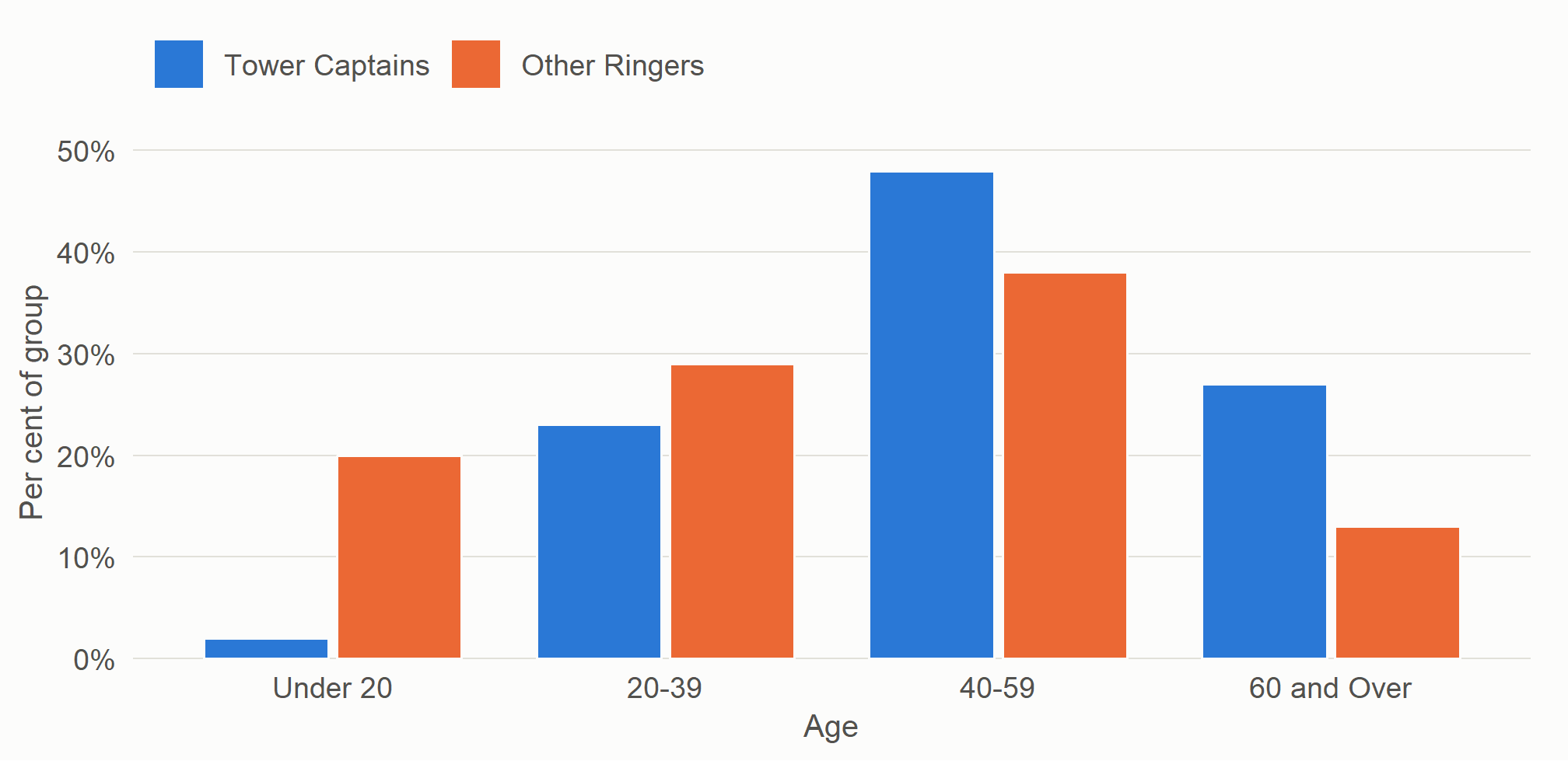
Table 10.1 shows that whereas there is only a slight preponderance of males among ‘ordinary ringers’ the post of tower captain is very much a male preserve. Tower captains are also older on average, not surprisingly given the substantial number of ringers aged under 20. (Ron Johnston tells us that both of these differences are statistically significant, and therefore almost certainly present in the populations from which the samples were drawn. He used a chi-square test in the first case and a Kolmogorov-Smirnov two-sample test in the second!) Tower captains were less likely to have attended an institution of higher or further education (a Z test of proportions this time!), probably reflecting their older ages.
The percentage of all ringers who have attended a University, Polytechnic or College is very much higher than in the population at large, clearly suggesting that campanology is very much a ‘middle class’ activity. This is confirmed by the occupational data provided by the 633 ringers currently in paid work; see Table 10.2. (Classification of occupations is an extremely difficult task, even for professionals, p. 47 so we have only a general picture here for our coder had some difficulties.) Fully 53 per cent have been categorised in what are known as the higher status white-collar occupations (the various professions plus management and administration) with a further 22 per cent in the more routine white-collar tasks. Very few ringers gave occupations that are typically classified as manual (or ‘blue-collar’, or ‘working class’), and none reported what are classified as ‘unskilled’ occupations, which is very different from the working population of the British Isles as a whole; fully 6 per cent are farmers, however, suggesting a ‘middle class’ preponderance in the rural areas as in the towns and cities.
Ringing Histories
When did they learn to ring, and how old were they then? Over half of all ringers, and substantially more than half of tower captains, learnt to ring in their ’teens. Less than one-in-five tower captains were older than 29 when they took up the Exercise, compared with one-in-three of all other ringers.
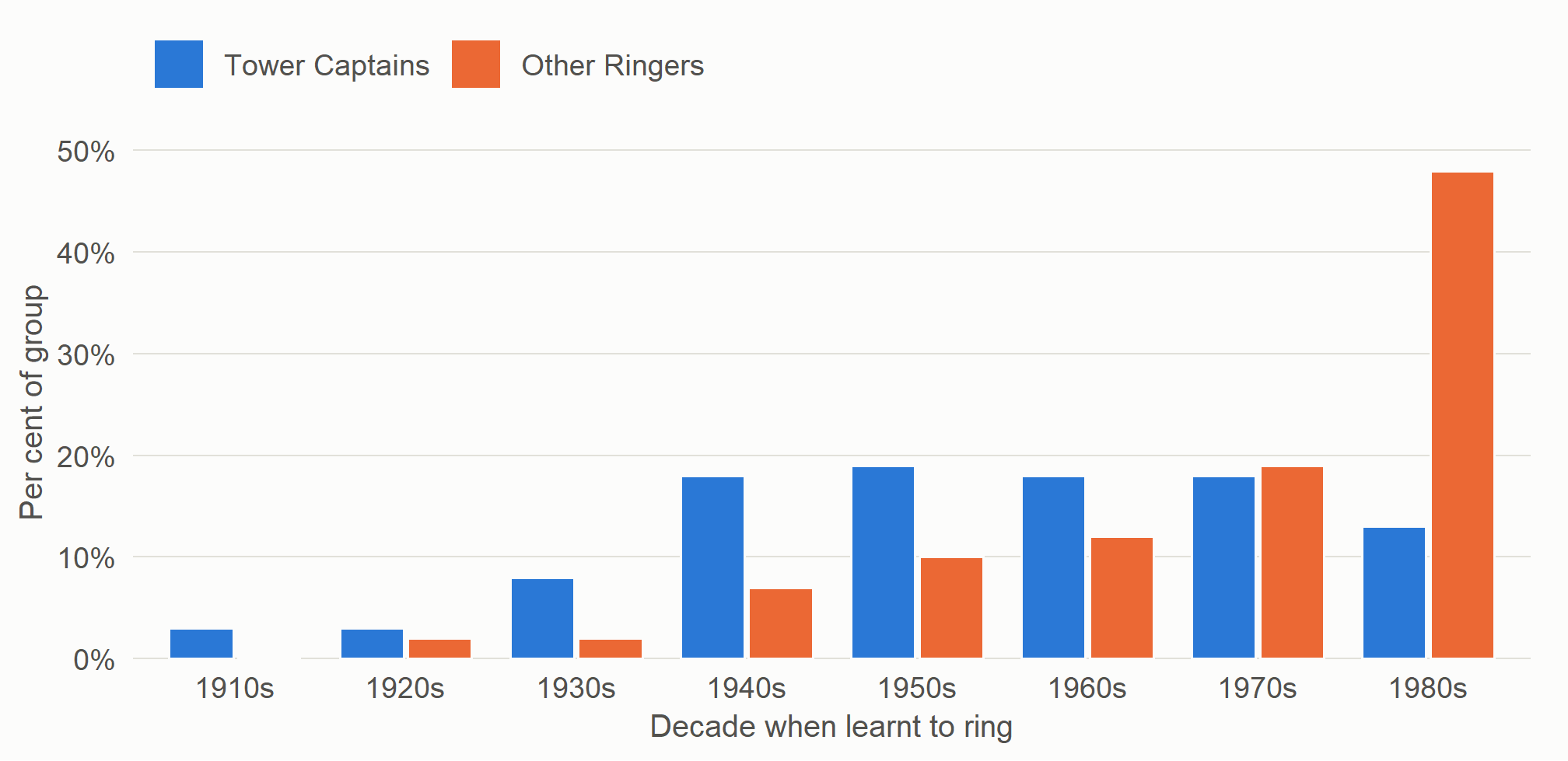
Tower captains took up ringing much longer ago, on average, than did other ringers, three per cent as long ago as the decade of the First World War. In part this is not surprising, for they are on average older. But the age difference alone is insufficient to account for the major disparity shown in the lower half of Table 10.3; nearly half of all ‘ordinary ringers’ took up campanology in the 1980s. The implication is of a relatively small, ‘hard core’ of people who have been active for a long time, a substantial number of whom are tower captains, and a much larger number of relatively recent recruits, a large number of whom will probably not remain active for many years, if past trends are any guide. (We asked the ‘other ringers’ if there had been a period of more than a year, after they were taught, when they had done no ringing: 30 per cent said yes, so clearly we are able to attract back a substantial number of those who for some reason become ‘lapsed ringers’.)
It is often claimed that ringing runs in families, and many who take it up do so because a close relative is already a ringer. Table 10.4 shows that at the time when they took up ringing, only one-in-seven had either a parent or a brother/sister who rang at the tower where they learned, and few had any other relative present. (Don’t assume that nearly one-third had a member of their immediate family also in the tower; many of those with a parent-ringer also had a sibling-ringer in the family.) Ringing is clearly quite a family activity for the present generation, however; nearly one-in-five of our respondents has a spouse who is also a ringer, for example.
Ringing Activities
What can they ring? Both groups were given a list of six methods and asked if they could ring them ‘inside’ - on any number of bells. The tower captains have wider repertoires (Table 10.5), but over half of all ringers have mastered Grandsire and/or Plain Bob ‘inside’ (to their own satisfaction at least), one-in-four can ring Cambridge Surprise, p. 48 and one-in-eight can ring Spliced Surprise. Less than two-thirds have ever rung a quarter-peal, however (a question not asked of tower captains) and only a small number had conducted one.
When it comes to peals, the tower captains are much more experienced, although nearly one-in-three of them have never rung one; of the other ringers, fully two-thirds have not experienced a first peal. The number who have rung 100 peals or more is small, even among tower captains. (We estimate from the samples that among the currently active Sunday-service ringers in the British Isles there are about 550 tower captains and about 1,900 other ringers who have rung at least 100 peals.)
Over half are regular attenders at services in the churches where they ring (Table 10.6), with tower captains slightly more so than others.
Most tower captains are members of a local Association, as are two-thirds of other ringers: tower captains are more likely to be/to have been active as an officer of an Association or one of its Branches/Districts. Average attendance at events during the previous 12 months was only twice, with as many as 47 per cent of “other ringers” recording that they had attended no events.
Penetration of The Ringing World is not great, with only just over half of all tower captains and one-third of “other ringers” seeing it regularly.
Some Attitudes
Finally, both groups were asked three sets of attitudinal questions, about ringing in general, about their own progress, and about the Associations.
The first set involved giving the respondents six statements which they were asked to agree or disagree with. The statements (with short titles for the table) were:
- The important thing is that the bells are rung on Sundays, not what methods are rung (Sunday ringing importance)
- Well-struck call-changes are preferable to less well-rung methods on Sundays (Call-changes well-struck)
- Most ringers are more concerned with learning methods than with striking properly (Methods not striking)
- Peals do little to advance the quality of Sunday ringing (Peals and Sunday ringing)
- Too many ringers put peal ringing before the encouragement of Sunday ringing (Peals before Sunday)
- Ringing has little part to play in modern church life (Ringing and Church Life)
Perhaps not surprisingly, there was general agreement with the first two statements (Table 10.7). Opinion was almost equally divided on each of the next three; that so many agreed with them suggests considerable scepticism among a large number of ringers regarding the merits of method-learning and peal-ringing. With regard to the last, it is of p. 49 more than passing interest that one-seventh of all ringers and one-ninth of tower captains agreed with a statement that ‘Ringing has little part to play in modern church life’, though of course we don’t know whether for them this was a normative statement or just a description of the contemporary situation.
The second set of questions was introduced by one that asked
Do you feel that you would like to advance further in your ringing, but are unable to?
As Table 10.7 shows, exactly half of the sample of ‘ordinary ringers’ answered yes, as did 57 per cent of tower captains: clearly there is a substantial population of frustrated ringers out there in the towers! Those who answered yes were then asked whether this frustrated desire to advance came about because:
- You feel you are not up to it.
- The band you ring with doesn’t provide the opportunities.
- The standard of ringing in your area is low
- Some other reason
Tower captains were much less likely than other ringers to see their own inability as the reason for lack of advancement (Table 10.7), and more of them saw the problem as the calibre of their band.
Finally, questions were asked about four aspects of the work of ringing Associations and their Branches/Districts. Both groups were asked for their opinion of what their Branch/District provided in terms of ringing meetings, ringing practices, social events, and ringing courses: they were asked to grade each according to three categories - ‘generally satisfactory’, ‘generally unsatisfactory’ and ‘no strong opinion’. The results are reported in Table 10.8; because substantial numbers didn’t answer (perhaps because they has no experience perhaps because the activities were not undertaken in their home area) we have added a fourth category of ‘no opinion given’.
Tower captains were more likely to find each of the four activities either generally satisfactory or generally unsatisfactory than the other ringers, more of whom either had no strong opinion or had no opinion to express. This suggests that a substantial number of ringers have little, if any, experience of the activities of the Association Branches/Districts; perhaps fewer would feel frustrated about their own progress if they did?
Ringers other than tower captains were asked the same set of questions with regard to activities of the Association itself, rather than its Branches/Districts. Although again very few found what is provided ‘generally unsatisfactory’, about 70 per cent had either no strong opinion or no opinion to offer, clearly indicating that the Associations are having little impact on a large proportion of the ‘ringing public’.
p. 50 What do we conclude from this analysis? Clearly ringing draws on a narrow social base, which may reflect the social structure of the church congregations or may tell us something about the appeal of ringing. Can it be widened? And the impact of the Associations on the average ringer appears to be weak. Again can it be widened; what can be done to involve more, for the good of ringing as a whole?
Chapter 10 Tables
Age is one of the cleanest comparisons the 2026 census can make with 1988. In 1988 one in five ordinary ringers was under 20, and tower captains were much older: three-quarters were 40 or over. The 1988 bands are broad (20-39, 40-59), so a 2026 comparison needs age bands that add up to these.
p. 51
The original prints this table in two blocks side by side, with “Professionals in” heading the first block. The group labels “Management” and “Other occupations” are ours.
Nearly half (48 per cent) of ordinary ringers in 1988 had learnt in the 1980s, within the previous nine years or so. A single snapshot like this mixes two things: a big recent cohort can mean recruitment had risen, or that many recruits leave within a few years and only a few stay for decades. The report reads it the second way (Chapter 10), and the 2026 census can test that by comparing the same distribution 38 years on.
p. 52
p. 53
The group labels in the first column are ours where the original has none, as for the two ‘in hand’ rows.
p. 54
p. 55
The group label “Reason for not advancing” is ours. The text says these reasons were asked of those who answered yes to the “Unable to Advance” question.
p. 56
The tower captains’ Branch/District figures repeat Table 7.5, except for social events: 47 and 3 here, 43 and 7 there.