Original report pages 81–83.
(Appeared in The Ringing World, 15 September 1989)
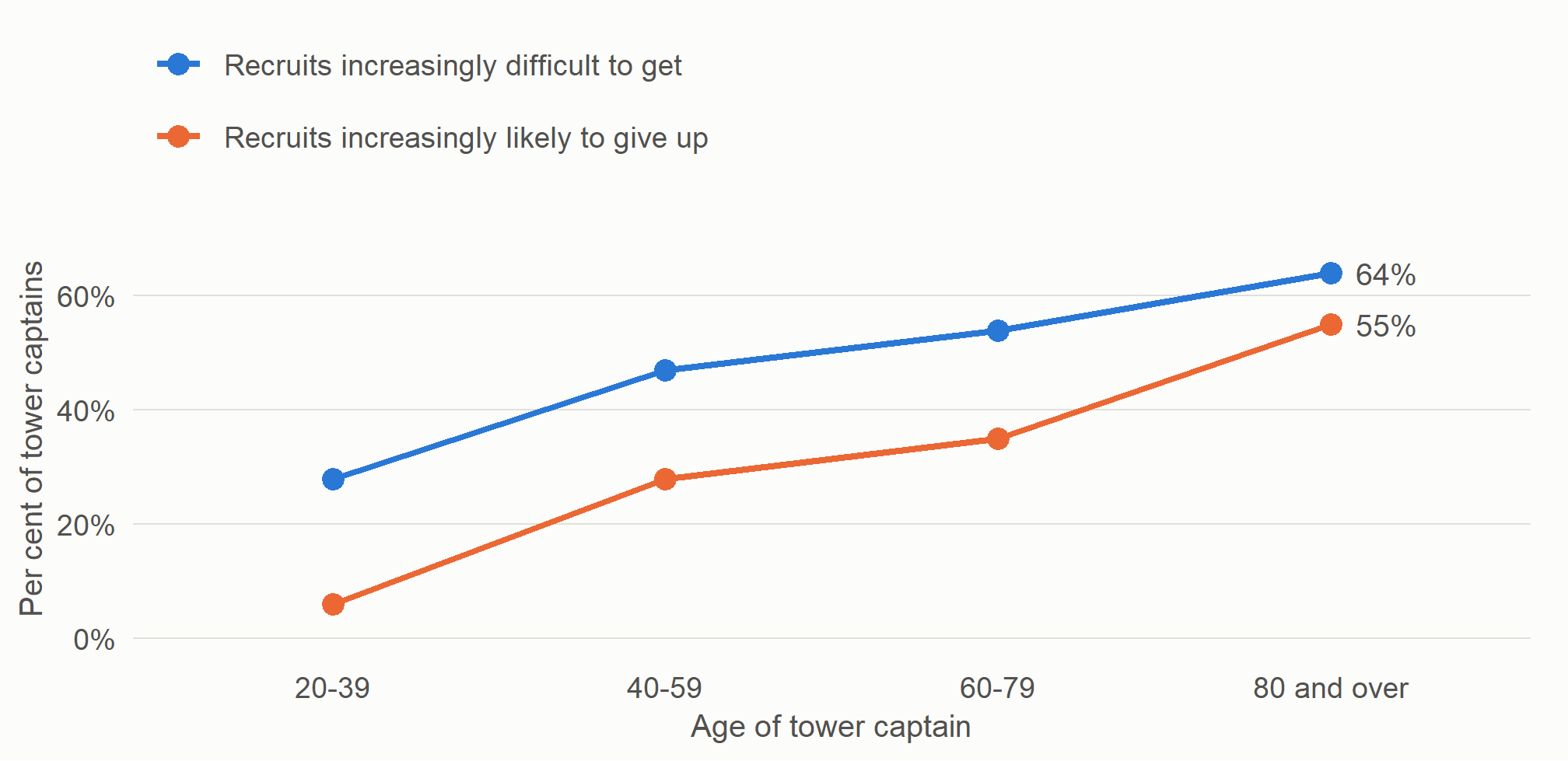
In an earlier article based on the Survey results (The Ringing World, 19 May 1989: Chapter 7), we reported that tower captains find getting recruits harder these days, and also that they find that recruits are less likely to stick with ringing. Further, we noted that the older tower captains were generally more pessimistic. The full figures are in Table 17.1.
What do we conclude from that? Some may suggest that the older tower captains are increasingly out of touch with the younger generation and do not recognise the need to provide a stimulating experience for learners, who will want to stay with ringing because of the interest and enjoyment they get from it. Others may argue that young learners want an enjoyable social life linked to ringing, and that it is unattractive if it is associated with ‘old fogeys’. Young ringing masters, on the other hand, are better able to recruit and retain learners, because they are aware of these issues, or so the argument goes. There is nothing in the table to say that this is the correct interpretation, however; the pattern there is consistent with the argument that younger ringing masters are more effective, but that is all.
The counter-argument to that just put is that the older ringing masters are the more experienced, and have a wider perspective on the problems of recruitment and retention than the younger ‘whipper-snappers’. Certainly Table 17.2 shows, as one would expect, that the older tower captains have spent longer in the job, on average. So is it experience that matters, or age?
Table 17.3 seeks to answer that question by correlating opinions about recruitment and retention with years of experience as a tower captain. The pattern is the same as that in Table 17.1, though less marked; in general, the longer tower captains have been in office the harder they find the process of getting and keeping recruits.
So which interpretation do you prefer? The data point to the relationship with age as being the more important, which suggests that young captains are the more likely to get and keep recruits for your tower; but even if they are relatively young, you probably shouldn’t keep them in office too long.
Is a healthy ringing Exercise one with a regular turnover of tower captains, then? The Survey Committee didn’t see its task as making those value judgements for you, but just to give you the information and suggest how it might be interpreted. The rest is over to you.
p. 82
Chapter 17 Tables
Both measures of pessimism rise steadily with the tower captain’s age. Chapter 17 discusses whether that reflects age or years in post, and concludes age matters more. The oldest group is small (11 tower captains), so its end of each line is the least certain.
Chapter 7 quotes some of these figures for 60 tower captains aged 20-39 and 63 aged 60-79, and gives 52 rather than 54 per cent of the older group finding recruits increasingly difficult. The bases here are 67 and 69.
p. 83